Start Your Shot List From a Brief, Not a Blank Page
Before you write a shot list, write a short brief: what you are making, who is filming, and what the edit needs. Then turn that into asks a person can actually film.
A shot list is the set of asks you send the people filming a UGC campaign. It is what makes the footage editable later. If the list is vague, you get atmosphere and not much you can cut. If it is long, people stop partway through. If one line asks for five things, you often get the first thing and a lot of leftover motion.
A useful list is short, usually one to five shots. Each shot is one ask, written in language someone can follow on a phone. The footage you cannot make the cut without belongs at the top. We walked through those rules in What Is a Shot List and How Do I Write One for a UGC Campaign?
This post is about the step before that list: a brief. Not a treatment. A short paragraph that says what you are making, who is filming, and what the edit needs. Once that is written down, the shot list is a translation job instead of a blank field.
Why start with a brief
The blank page is hard because a campaign is a paragraph of intent, and a shot is a physical action. Those are different kinds of writing. You can know the campaign well and still not know the first line of the list.
A brief holds the intent in one place so you can pull shots out of it. Who is holding the phone. Where they are. How long they have. What the cut actually needs, such as a 30-second social, a store recap, or a few testimonials.
Without that, lists tend to swallow the whole campaign in one line. "Capture authentic energy." "Get a hero, a product demo, three soundbites, and a wide of the room." Those sentences describe a video. They do not tell a person what to do with a phone.
Starting from a brief does not write the list for you. It gives you material to edit. First-draft shots should still be short, filmable asks. You still decide which ones belong, which ones are two asks in one sentence, and which ones sound like a slide instead of a person.
What belongs in the brief
You need enough for the list to be useful. You do not need a brand story.
Say what you are making. "Employee clips for a product launch. We need a 30-second social cut" is a brief. "We are a purpose-driven brand empowering everyday athletes" is not, because a filmer cannot act on it.
Name who is filming. Store staff after close. Customers who already bought the product. Run-club members with ten minutes before the group leaves. People film differently on the clock than they do at a concert, and the list should match that.
Name the setting and the time they actually have. A locker room, a sales floor, a driveway, a festival pit. If they have four minutes, a list that needs twenty will not get done.
Name what the edit needs. If you need one line to camera, say so. If you need hands on the product, say so. If you need movement, say the path: walk in, lace up, start the jog. The closer the brief is to the cut, the closer the first list will be to shots.
Leave out what a filmer cannot do anything with. Media mix, KPI language, "make it feel premium." That can wait for your own pass on the list.
What a filmable ask looks like
A shot is something a person can do in one take without rereading the sentence.
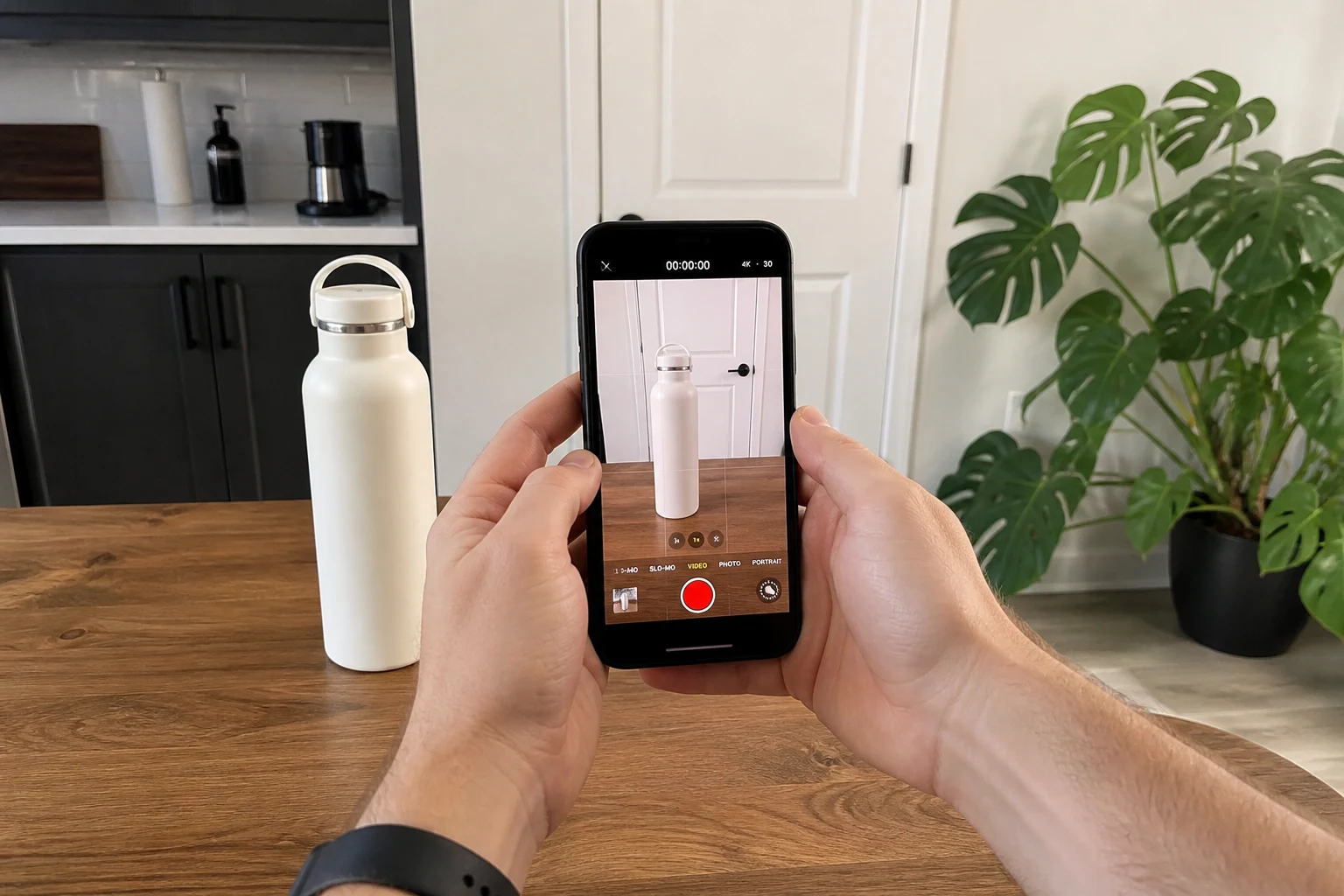
Here is a brief that is usable, and a shot that tries to do too much.
Brief: "Customers film a quick review of the new bottle after a workout."
Overloaded shot: "Show us your workout, talk about why you love the bottle, get a close-up of the logo, and end on a smile."
That line is four asks. In practice you often get a ramble, a logo if you are lucky, and no clean place to start the clip in an edit.
The same brief, split into four shots:
- Hold the bottle at chest height and take a sip. Keep it casual.
- Tilt down to your hands and unscrew the lid. Slow is fine.
- Look at the camera and say one sentence about how it feels after a workout.
- Set the bottle on the bench and take two steps back so we see you and the gym.
Each line is one action you can check off. The campaign did not change. The asks did.
Language matters as much as structure. Compare these:
"Capture authentic, high-energy B-roll of the event atmosphere from multiple angles."
"Stand near the entrance and film people walking in for ten seconds. You do not need to talk."
The first describes a feeling. The second describes a place, a duration, and whether they need to speak. Warm here does not mean vague. It means the person filming can tell they are being directed, not graded.
If a first-draft shot looks like the overloaded examples, rewrite it before anyone else sees the list. A draft from a brief is there so you are not staring at an empty field. It is not finished direction until you edit it.
How to read the first draft
Use the same checks you would use on a list you wrote by hand.
Length. One to five shots is the range most people will actually film. Seven only if you have a reason. A brief can describe a whole campaign. The list filmers see cannot.
One ask. If a line has "and," it is often two shots. Split them.
Language. "Hold the phone at chest height and walk toward the door" tells someone what to do. "Deliver a dynamic entrance in vertical, branded, and on-brief" does not, even if everyone on the marketing team knows what you meant.
Order. If they only film one clip, it should be the clip you cannot cut without. First drafts often lead with a pretty wide. Put the line to camera, the product in hand, or the moment the night is about at the top.
The earlier post is the longer write-up on those rules. This one is the step in front of them: write a brief, then make a list, then rewrite the list.
A short example: launch clips, not a novel
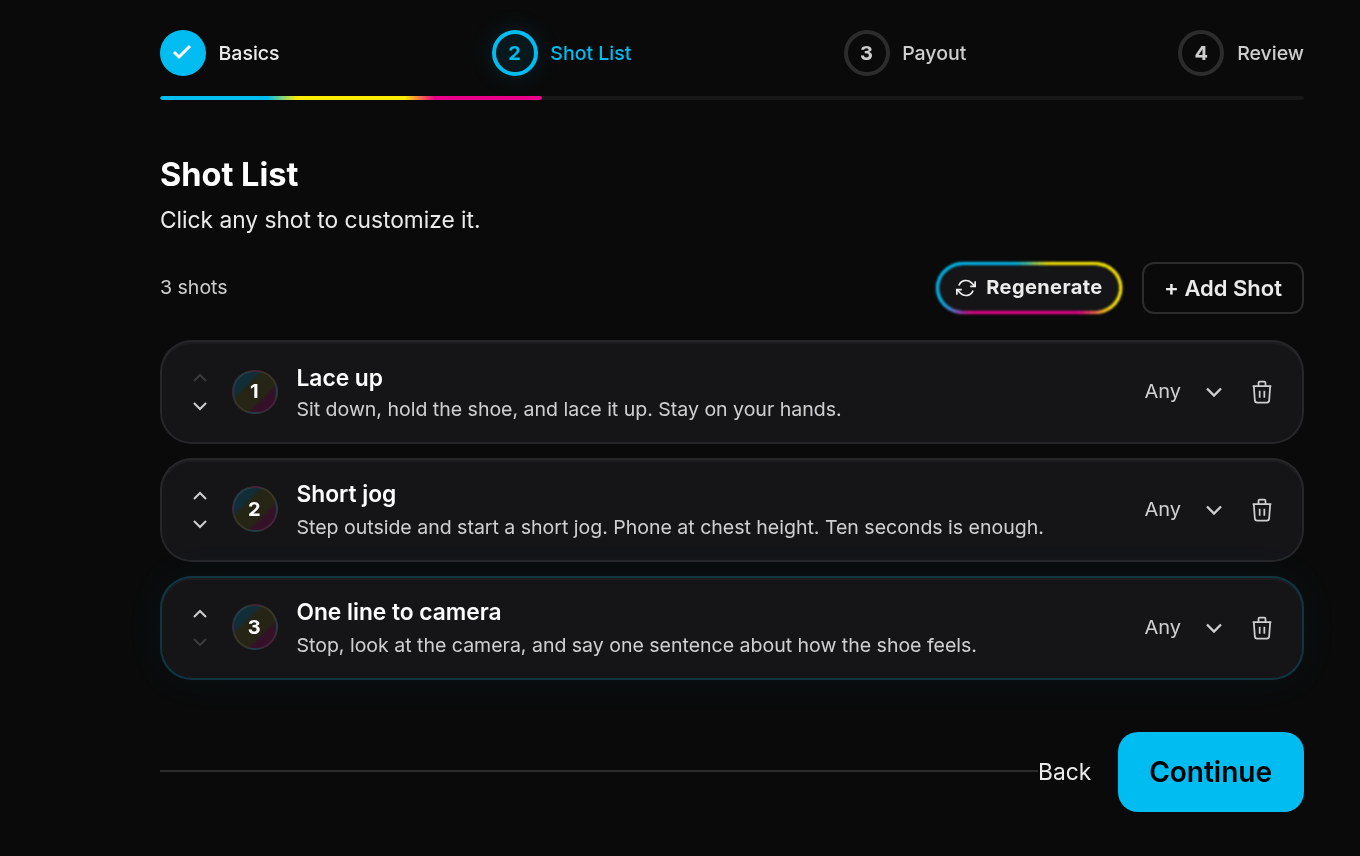
Imagine a running-shoe launch. Filmers are store staff and a few local run-club people. You need a 30-second social cut by the end of the week. Phones only, after work.
A brief that can support a list:
"Launch clips for the new shoe. We need a 30-second social: hands lacing up, a short outdoor jog, and one line on how it feels. Filmers are store staff and run-club members, filming on their phones after work. Keep it to a few shots. They have about ten minutes."
From that, a first pass might look like this:
- Sit down, hold the shoe, and lace it up. Stay on your hands.
- Step outside and start a short jog. Phone at chest height. Ten seconds is enough.
- Stop, look at the camera, and say one sentence about how the shoe feels.
- Optional: a wide of the block or trail you just ran.
Then edit it. If the line to camera is the hero of the cut, move it to shot one, because people drop off and the first ask is the one you are most likely to get. If ten minutes is real, cut the wide. You can usually live without it. The lace-up and the line are harder to replace.
Rewrite shot 3 so it does not feel like a test. "Whenever you are ready, look at us and tell us one thing about how it feels. One sentence is perfect." Same ask, easier to do on a sidewalk after work.
Resist adding the box, the storefront, a group shot, and a sunset because the brief mentioned a launch. That is how a five-shot list turns into homework.
Send the list. Watch the first clips. If shot two is coming back too soft to use, change the line. A shot list is direction. It can move when the footage tells you something.
The brief is the start. The list is still yours.
A UGC campaign still depends on the shot list: short, one ask at a time, important shots first, written so a person can film it.
You do not have to start that list from an empty field. Describe the thing you are actually making. Turn it into a short set of filmable asks. Cut it down, warm up the language, and put the shot you need most at the top.
The people on the other end of the link should know what to film. You should know what you are going to cut. That is the job. A brief is just a way to begin it without guessing.